Ankle Sprain: Complete Evidence-Based Guide to Recovery

Introduction
An ankle sprain is one of the most common musculoskeletal injuries, affecting people of all ages—from athletes to individuals who simply misstep while walking. Although many ankle sprains heal with appropriate care, inadequate treatment or returning to activity too soon can lead to chronic ankle instability, recurrent sprains, and long-term functional limitations. Research shows that up to 40% of individuals may continue to experience pain, instability, or recurrent sprains after an ankle injury if rehabilitation is incomplete. Early assessment and structured rehabilitation are therefore essential for optimal recovery. This guide explains everything you need to know about ankle sprains based on current clinical evidence.
What Is an Ankle Sprain?
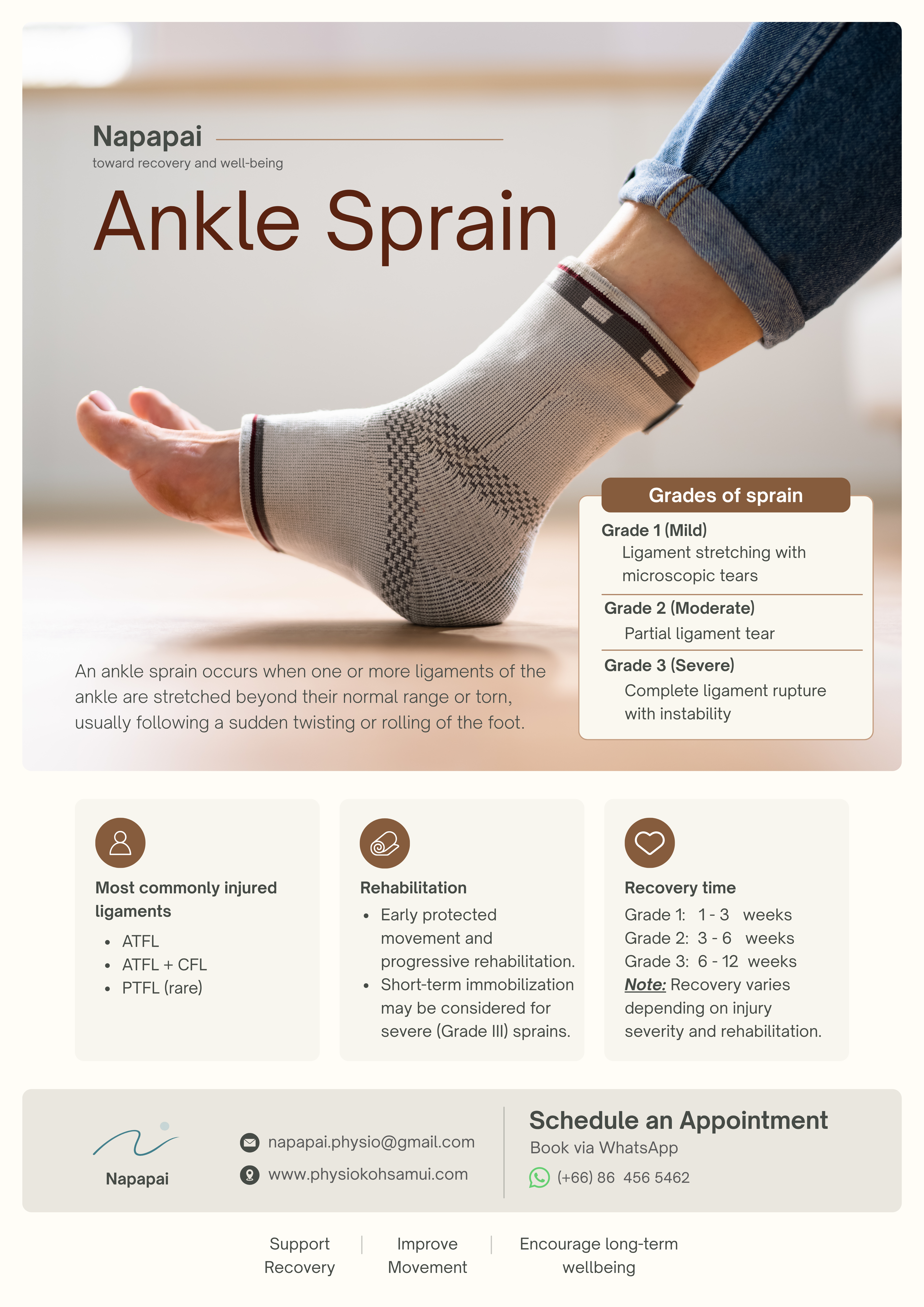
An ankle sprain occurs when one or more ligaments that stabilize the ankle are stretched beyond their normal physiological limit or torn. Ligaments are strong bands of connective tissue that connect bones and help maintain joint stability. The majority of ankle sprains occur when the foot suddenly rolls inward (inversion injury), placing excessive stress on the lateral ankle ligaments.
Which Ligaments Are Most Commonly Injured?
Approximately 85% of ankle sprains involve the lateral ligament complex. The three primary lateral ligaments include:
Anterior Talofibular Ligament (ATFL)
- Most commonly injured
- Usually damaged during plantarflexion with inversion
- Frequently involved in Grade I and Grade II sprains
Calcaneofibular Ligament (CFL)
- Often injured together with the ATFL
- Provides stability during weight-bearing
Posterior Talofibular Ligament (PTFL)
- Strongest lateral ligament
- Rarely injured
- Usually associated with severe ankle trauma
What Causes an Ankle Sprain?
Common causes include
- Rolling the ankle while walking
- Landing awkwardly after jumping
- Running on uneven surfaces
- Sports involving cutting or pivoting
- Slipping or falling
- Previous ankle sprain
A previous ankle sprain is one of the strongest risk factors for another sprain.
Signs and Symptoms
Symptoms may include
- Sudden ankle pain
- Swelling
- Bruising
- Difficulty walking
- Tenderness around the ankle
- Feeling unstable
- Reduced ankle movement
Severe injuries may also involve inability to bear weight immediately after injury.
Ankle Sprain Grades
Grade I (Mild)
Ligament fibers are overstretched with microscopic tearing. Typical findings
- Mild swelling
- Minimal instability
- Able to walk
- Mild pain
Recovery1–3 weeks
Grade II (Moderate)
Partial ligament tear. Typical findings
- Moderate swelling
- Bruising
- Pain during walking
- Reduced stability
Recovery3–6 weeks
Grade III (Severe)
Complete ligament rupture. Typical findings
- Severe swelling
- Significant instability
- Difficulty bearing weight
- Marked loss of function
Recovery 6–12 weeks or longer Recovery varies depending on associated injuries and rehabilitation.
When Should You See a Healthcare Professional?
Seek assessment if you experience
- Inability to bear weight
- Significant swelling immediately after injury
- Severe pain
- Visible deformity
- Persistent symptoms after one week
- Numbness
- Recurrent ankle sprains
Clinical assessment may determine whether imaging such as X-rays is necessary using validated decision rules such as the Ottawa Ankle Rules.
Diagnosis
A physiotherapist or physician will evaluate
- Injury mechanism
- Swelling
- Bruising
- Tenderness
- Ligament integrity
- Range of motion
- Strength
- Balance
- Functional movement
Special tests may include
- Anterior Drawer Test
- Talar Tilt Test
Should You Get an X-ray?
Not everyone needs imaging. The Ottawa Ankle Rules help clinicians identify patients who are likely to have a fracture and reduce unnecessary X-rays while maintaining excellent diagnostic accuracy.
Initial Treatment
Current clinical guidelines recommend
Protect
Avoid activities that increase pain.
Compression
Compression bandages or ankle braces may reduce swelling.
Elevation
Elevate the ankle above heart level whenever possible.
Early Weight Bearing
Evidence suggests that early protected movement and progressive weight bearing are generally superior to prolonged immobilization for most Grade I and Grade II sprains.
Should You Use Ice?
Ice may help reduce pain in the short term. However, current evidence suggests that ice has limited influence on long-term healing. Ice can therefore be used primarily for pain management rather than to accelerate ligament healing.
Why Physiotherapy Matters
Physiotherapy focuses on restoring
- Joint mobility
- Muscle strength
- Balance
- Proprioception
- Walking mechanics
- Sport-specific function
Supervised rehabilitation has been shown to reduce recurrent ankle sprains and improve long-term outcomes.
Rehabilitation Phases
Phase 1
Goals
- Reduce pain
- Reduce swelling
- Restore gentle movement
Examples
- Ankle pumps
- Toe movements
- Gentle ankle circles
Phase 2
Goals
- Restore mobility
- Improve strength
Exercises
- Calf raises
- Resistance band exercises
- Heel-toe walking
Phase 3
Goals
- Improve balance
Exercises
- Single-leg stance
- Balance board
- Star Excursion Balance exercises
Phase 4
Goals Return to sport Exercises
- Hopping
- Agility drills
- Jump landing
- Direction changes
Recovery Timeline
| Injury | Recovery |
|---|---|
| Grade I | 1–3 weeks |
| Grade II | 3–6 weeks |
| Grade III | 6–12+ weeks |
Individual recovery varies depending on injury severity, age, previous injuries, and rehabilitation adherence.
Can You Walk on a Sprained Ankle?
Many people can still walk after a Grade I sprain. However, walking through significant pain or instability may delay recovery. If walking causes severe pain or limping, professional assessment is recommended.
Can an Untreated Ankle Sprain Become Chronic?
Yes. Without appropriate rehabilitation, patients may develop
- Chronic ankle instability
- Recurrent sprains
- Persistent pain
- Balance deficits
- Reduced sports performance
This is why rehabilitation should continue even after pain improves.
Frequently Asked Questions
Should I wear an ankle brace?
Short-term bracing may improve stability during the early recovery phase and during return to sport.
When can I return to running?
Return only after pain-free walking, near-normal strength, full ankle range of motion, and satisfactory balance have been restored.
Do I need surgery?
Most ankle sprains are successfully managed without surgery. Surgical treatment is generally reserved for selected severe injuries or chronic instability after failed rehabilitation.
Key Takeaways
- Most ankle sprains involve the ATFL.
- Early assessment improves recovery.
- Exercise rehabilitation is essential.
- Most Grade I and II sprains recover without surgery.
- Completing rehabilitation reduces the risk of future sprains.
References (Evidence-Based)
- Martin RL, et al. Clinical Practice Guideline: Lateral Ankle Ligament Sprains. Journal of Orthopaedic & Sports Physical Therapy (JOSPT). 2021.
- Doherty C, et al. Clinical Guidelines for Acute Lateral Ankle Sprain. British Journal of Sports Medicine.
- Vuurberg G, et al. Diagnosis, treatment and prevention of ankle sprains. British Journal of Sports Medicine. 2018.
- Fong DT, et al. A systematic review on ankle injury epidemiology.
- Gribble PA, et al. Evidence review on chronic ankle instability.